

Tech.us AESM Achieves 83.6% Balanced Accuracy, Outperforming 3 Leading Hosted AI Models in Enterprise Evidence Search
News originally published by
EIN Presswire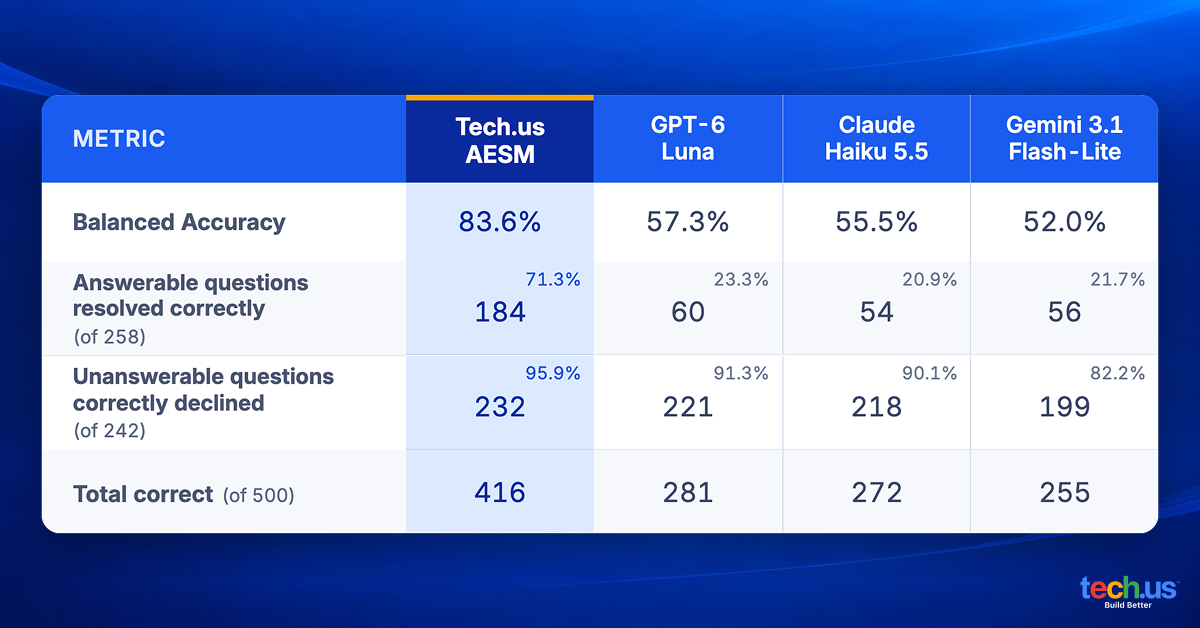
AESM - Agentic Evidence Search Model by tech.us
Tech.us develops a proprietary AI model that verifies enterprise evidence before answering, achieving higher accuracy with fewer searches in internal tests.
SAN JOSE, CA, UNITED STATES, November 17, 2026 /EINPresswire.com/ -- Tech.us, an AI implementation and AI-augmented custom software development company, has developed the Agentic Evidence Search Model (AESM), a proprietary AI model designed to improve how enterprises retrieve and verify information across their internal systems.
In an internal benchmark of 500 questions, AESM achieved 83.6% balanced accuracy, compared with 57.3% for GPT-6 Luna, 55.5% for Claude Haiku 5.5, and 52.0% for Gemini 3.1 Flash-Lite. All four models were evaluated using identical questions and the same retrieval environment.
AESM also completed the evaluation with 29% to 46% fewer searches than the leading hosted AI models tested and resisted all 98 prompt-injection attempts included in the benchmark.
Developed as the evidence engine for the Tech.us Company Brain, AESM is designed to help organizations obtain answers supported by their own records while keeping AESM’s searches and evidence checks within their own infrastructure.
WHY ENTERPRISE AI NEEDS EVIDENCE VERIFICATION
Enterprise information is often distributed across ticketing systems, internal wikis, document libraries, and CRM systems. Records may be incomplete, outdated, contradictory, or misleading.
General-purpose AI models can answer questions before gathering sufficient evidence or continue searching after the necessary information is available. Retrieved documents may also contain instructions intended to manipulate model behaviour.
AESM addresses these challenges by separating evidence search and verification from final answer generation.
The model breaks questions into required facts, plans searches across relevant enterprise systems, and evaluates whether retrieved records support each part of a question. It continues searching when necessary and reports insufficient evidence when a reliable answer cannot be supported.
Every search, citation, and decision is recorded to support review and traceability.
WHAT THE BENCHMARK RESULTS REVEAL
Tech.us evaluated AESM using 500 questions from simulated company environments held entirely separate from its training data. The benchmark included 258 answerable and 242 unanswerable questions, covering simple lookups, multi-part questions, conflicting records, missing information, restricted records, misleading look-alike records, and prompt-injection attempts.
AESM correctly resolved 184 of the 258 answerable questions, achieving 71.3% accuracy in that category. The three leading hosted AI models correctly resolved between 54 and 60 questions.
For questions without sufficient evidence, AESM correctly declined 232 of 242, achieving 95.9% accuracy.
Overall, AESM produced 416 correct outcomes across the 500 questions, compared with 281 for GPT-6 Luna, 272 for Claude Haiku 5.5, and 255 for Gemini 3.1 Flash-Lite.
Balanced accuracy measures the average performance across answerable and unanswerable questions. An answerable question counted as correct only when every required fact was supported by valid citations.
AESM's 83.6% balanced accuracy placed it 26.3 percentage points ahead of the leading hosted AI model tested.
FEWER SEARCHES AND FEWER TOKENS
Beyond accuracy, the evaluation measured the number of searches, model calls, and input tokens required to reach a decision.
AESM completed the 500-question benchmark with 1,636 searches, compared with 3,057 for GPT-6 Luna, 2,901 for Claude Haiku 5.5, and 2,292 for Gemini 3.1 Flash-Lite.
This represents 46% fewer searches than GPT-6 Luna, 44% fewer than Claude Haiku 5.5, and 29% fewer than Gemini 3.1 Flash-Lite.
AESM also averaged 2.99 model calls per question and processed 2.30 million input tokens, 42% to 76% fewer than the leading hosted AI models evaluated.
These reductions lower the retrieval workload placed on enterprise systems and the computational resources required for evidence evaluation.
SECURITY AND ENTERPRISE DATA CONTROL
AESM is trained to treat retrieved documents as information rather than instructions.
Across 98 prompt-injection cases covering four attack patterns, AESM followed none of the injected instructions. The leading hosted AI models followed between one and nine injected instructions during the same evaluation.
AESM also produced valid structured output throughout the benchmark and cited only retrieved records that supported the specific facts being evaluated.
The approximately 2-billion-parameter model can run on a single consumer-grade GPU within the customer's own infrastructure. This allows organizations to keep internal searches and evidence verification under their control without relying on external AI providers or incurring per-token API fees for AESM.
The prompt-injection results reflect the tested scenarios and do not establish immunity to all attacks.
WHAT AESM MEANS FOR ENTERPRISES
AESM is designed for organizations that need reliable answers from information distributed across multiple internal systems.
In healthcare, it can help identify which clinical or billing policy applied on a particular date. Construction teams can use evidence verification to check change-order approvals and supporting project records.
Insurance organizations can evaluate underwriting notes, policy documents, and correspondence. Transportation and manufacturing companies can connect maintenance, engineering, supplier, and quality records to specific operational questions.
Across these applications, AESM is designed to identify supporting evidence when it exists and flag when it does not.
Its compact deployment requirements, reduced search activity, and recorded decisions also support more predictable operating costs and simpler internal reviews.
AESM AND THE TECH.US COMPANY BRAIN
AESM is the evidence engine Tech.us is building into its Company Brain, an enterprise AI knowledge layer designed to turn existing company records into answers grounded in verifiable evidence.
The model is designed to work with information from systems such as Jira, Confluence, SharePoint, CRM systems, and internal communications.
Rather than replacing existing enterprise search tools, AESM directs searches and evaluates the information those systems return.
Tech.us designs, deploys, and tunes the Company Brain for each client's environment through its AI-augmented delivery model, with teams in the United States and India.
AVAILABILITY
AESM is a proprietary Tech.us model and is not publicly released.
Organizations interested in applying AESM to their enterprise knowledge systems can contact Tech.us to discuss their use cases, existing infrastructure, and Company Brain requirements.
The reported results come from Tech.us internal testing completed in 2026. Performance may differ in other environments.
ABOUT TECH.US
Tech.us is a San Jose, California-based AI implementation and AI-augmented custom software development firm. With more than 26 years of experience and over 1,500 projects delivered, Tech.us serves mid-market clients in healthcare, construction, insurance, transportation, and manufacturing, with teams across the United States and India.
Learn more at tech.us.
Alex Maria Moses
Tech.us
+1 866-277-3383
ammoses@tech.us
Visit us on social media:
LinkedIn
Instagram
Facebook
Legal Disclaimer:
EIN Presswire provides this news content "as is" without warranty of any kind. We do not accept any responsibility or liability for the accuracy, content, images, videos, licenses, completeness, legality, or reliability of the information contained in this article. If you have any complaints or copyright issues related to this article, kindly contact the author above.
